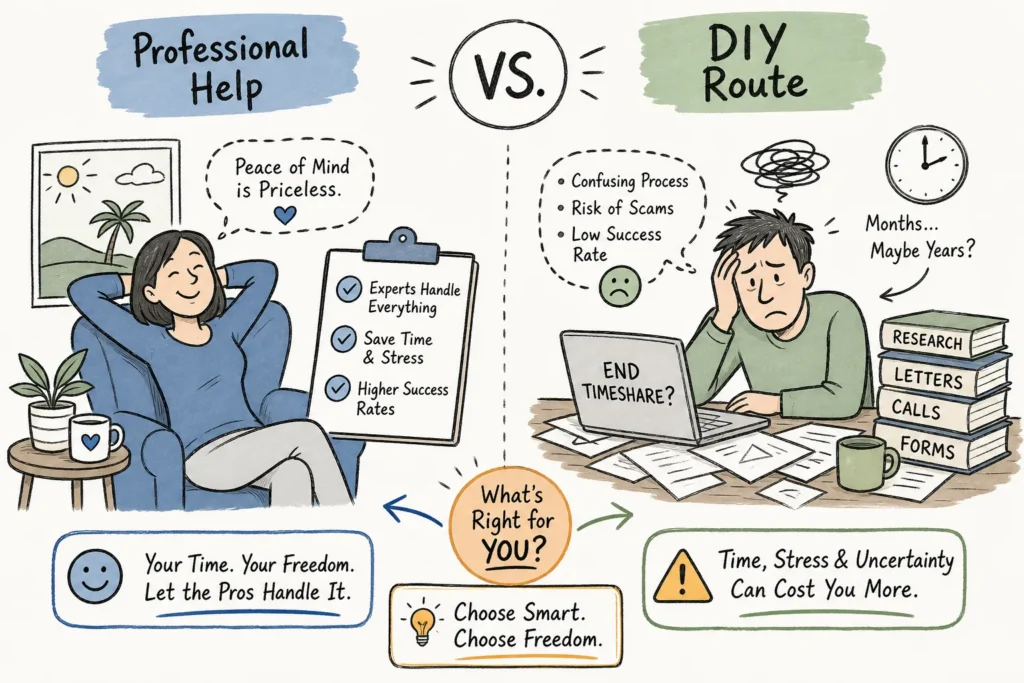
When weighing a timeshare exit company vs. DIY, the details that actually matter are costs, timelines, and realistic odds of success, not the version of the choice that sounds clean in your head. Many owners describe the decision this way: handle it yourself and save money, or pay a company and hope they actually deliver. Neither option feels simple. One path costs time and carries no safety net. The other costs real money and requires trusting a stranger with your contract. What’s missing from that mental model is specifics. Real costs. Real timelines. Real odds of success depending on where you are in the process.
This is a straight comparison of both paths, built around what actually happens at each stage. For context, companies like Liberty Timeshare Resolution have helped more than 30,000 timeshare owners cancel their contracts and have eliminated over $350 million in timeshare-related obligations. That number isn’t a sales pitch. It’s a benchmark that helps you understand what professional help actually looks like when it’s done right. Use this comparison to figure out which path fits your situation.
DIY vs. timeshare exit company: the cancellation path
There are three realistic routes an owner can take without paying a third party. Each has a different timeline, a different set of requirements, and a different chance of working depending on when you’re reading this relative to when you bought.
The rescission window: your fastest and cleanest option
If you just purchased your timeshare, this is the most powerful legal tool you have. Most states grant buyers a rescission period, typically between 3 and 15 days depending on the state and the terms of your contract, though the trigger date varies. Some states start the clock at signing; others start it upon receipt of required disclosures or delivery of the contract documents. Check your state’s specific statute and your contract’s rescission language before assuming when the window opens or closes. Rescission is a statutory right, meaning no resort can take it away, but you have to use it precisely. Follow the notice method specified by your contract or state law, certified mail is commonly recommended, send it to the exact address listed in the contract, use the correct wording, and keep your delivery confirmation. One missed detail can make the attempt legally void.
Resort deed-back and surrender programs: slower and less certain
Outside the rescission window, some resorts offer deed-back or surrender programs that let owners relinquish their ownership voluntarily. The process involves contacting owner services, requesting the surrender packet, submitting ownership documents, and waiting for the resort to review and approve the request. The catch: most resorts require the account to be completely current, no unpaid maintenance fees, no outstanding mortgage, and no delinquent assessments. If your account has any of those issues, you likely won’t qualify. Resorts that do have formal programs can take anywhere from a few weeks to six months to process a surrender, and timelines vary case by case. Many resorts simply don’t have a program at all and will tell you that directly.
Private resale: the longest shot
The private resale path involves listing your timeshare on secondary marketplaces, finding a buyer, and closing through a title or escrow company. The reality of the timeshare resale market in 2026 is blunt: most timeshares sell for a few hundred dollars, and many list for nothing just to get rid of the ongoing obligation. Even if you find a buyer, the closing process typically takes two to eight weeks after the sale. If there’s still a loan attached to the timeshare, most resorts and title companies require that debt to be resolved before the transfer can go through, which removes resale as a clean option for owners still carrying a mortgage.
The costs and risks most DIY attempts don’t account for
The appeal of handling it yourself is obvious: no company fees. But the full cost calculation is more complicated than the upfront number suggests. Consider what’s at stake if the exit stalls for six months while maintenance fees continue accruing, that ongoing obligation alone can run into the thousands before the process resolves.
What “free” actually costs in time and effort
Based on documented forum threads and consumer complaint narratives, owners pursuing DIY timeshare termination steps typically spend dozens of hours across many months: pulling ownership documents, navigating resort phone trees, researching state-specific rescission laws, preparing certified mail, and following up repeatedly with no clear status updates. That time has real value, and it compounds when maintenance fees continue to accrue throughout the process. The financial clock doesn’t pause while you’re working through the paperwork.
What happens when the DIY attempt fails
If the deed-back is rejected, the resale falls through, or the rescission attempt had a procedural flaw, you restart from zero but are further behind than before. Maintenance fees still accrue. If you stop payments out of frustration, or worse, on the advice of a predatory exit company, the consequences can include collections, credit damage, and foreclosure proceedings that take years to unwind. The failed DIY attempt doesn’t just cost time. It can leave you in a worse legal and financial position than when you started.
What professional timeshare exit services actually deliver
When professional help is done right, it looks fundamentally different from the DIY experience. The difference is process with accountability versus improvised problem-solving with no fallback.
A structured process versus figuring it out alone
Liberty Timeshare Resolution uses a four-step process: financial analysis of the ownership, development of a cancellation strategy, credit management through its Credit-Safe Cancellation Process, and a confirmed written release from the timeshare obligation. Compare that to the typical DIY experience: calling owner services, being transferred between departments, and eventually being told to submit a written request with no timeline provided. One is a repeatable system built on thousands of prior cases. The other is guesswork with a resort that has no incentive to cooperate.
Credit protection throughout the exit, not just at the end
Unlike professional exit services, DIY typically does not include active credit monitoring or professional credit management unless you arrange it separately. Liberty Timeshare Resolution protects your credit throughout the process with its Credit-Safe Cancellation Process. For owners who are already financially stressed, this matters. A failed or slow exit that damages credit adds years of downstream consequences to an already difficult situation
What a money-back guarantee actually means for the risk calculation
Professional cancellation services vary in cost depending on contract complexity. Liberty Timeshare Resolution backs its process with a full, 18-month money-back guarantee if cancellation isn’t completed within the agreed timeframe. Confirm the specific terms directly with the company before signing. DIY offers no financial guarantee, by definition. For owners who’ve already spent months on owner services calls that led nowhere, or who’ve tried a deed-back and been rejected, a guaranteed-outcome structure changes the math entirely. You’re not paying for effort. You’re paying for a result, and Liberty absorbs the risk if it doesn’t happen.
How to spot a timeshare exit scam before it costs you
The timeshare exit industry has real bad actors. Understanding what fraud looks like helps you evaluate any company you consider, and it clarifies why established, transparent firms operate so differently.
Red flags documented by the FTC, BBB, and state attorneys general
The complaint patterns are consistent across regulatory sources. Watch for large upfront fees with no performance record, promises to cancel “any” contract fast and without consequences, instructions to stop paying your resort immediately (which leads to default and credit damage), and sales pressure to sign the same day without reviewing anything with a lawyer. State attorney general offices across the country regularly receive complaints about companies that target financially stressed or older owners with inflated guarantees and misleading legal claims. The FTC has specifically warned that companies promising to eliminate timeshare obligations with no downside are frequently collecting fees and delivering nothing.
What a legitimate exit company discloses before you pay
A trustworthy firm puts everything in writing before you commit: the exact fee structure, the money-back guarantee policy, the timeline range, what “success” means in their specific process, whether licensed attorneys or legal professionals are involved, and verifiable third-party reviews or track records. Any company that discourages you from reviewing the contract with your own attorney or getting a second opinion is waving a significant red flag. Legitimate companies expect questions because they have honest answers ready.
Timeshare exit company vs. DIY: direct comparison
Here is where the two paths stand side by side on the dimensions that matter most for the decision.
Costs, timelines, and success odds compared honestly
Choosing a timeshare exit company vs. DIY ultimately comes down to where you are in the process and what risks you can absorb. DIY costs less upfront but carries no guarantee, can stretch 12 or more months without resolution, and depends heavily on factors outside your control: the resort’s policies, your financial standing with the resort, and whether the rescission window was still open at the time of action. Professional exit services cost more, but reputable firms with a verified track record and a money-back guarantee transfer the financial risk onto themselves. Liberty Timeshare Resolution’s record of 30,000-plus completed exits and $350 million-plus in eliminated obligations is a measurable benchmark. DIY has no comparable metric because there is no system, no documentation, and no accountability structure behind it.
What type of owner each path actually suits
DIY makes the most sense in exactly one scenario: you are still inside the rescission window and can execute the cancellation correctly within days of purchase. Act immediately and do not pay anyone to help with that process. Outside that narrow window, the complexity increases sharply. Resort resistance, credit exposure during a prolonged attempt, and the difficulty of navigating deed-back eligibility requirements make professional help worth serious consideration. For owners carrying a mortgage, dealing with an inherited timeshare, or recovering from a prior failed attempt, the professional path removes obstacles that DIY simply cannot navigate.
How to decide which exit path fits your situation
Three questions settle most of the uncertainty here. Answer them honestly and the right path becomes clear.
First, are you still within the rescission period? If yes, act immediately. Send written cancellation using the method required by your contract or state law, today. Do not pay anyone to do this for you. Second, have you already tried DIY and been stonewalled by the resort? If yes, more months of the same approach will produce the same result. A structured professional process is more efficient than continued runaround. Third, do you still have a loan attached to the timeshare? If so, your resale and deed-back options narrow significantly, and working with a firm that has credit and debt management experience becomes more important, not less.
If you’re not sure where you stand, Liberty Timeshare Resolution offers a free, no-obligation consultation with exit specialists, along with an online eligibility check that tells you quickly whether your contract qualifies for cancellation. Before committing months to DIY research or writing a check to a company you’re uncertain about, that free check costs nothing and tells you in minutes whether professional help is actually necessary.
The bottom line on both paths
Many owners find they aren’t in a position to exit successfully on their own. The rescission window is already closed. The resort won’t cooperate with a deed-back. They’ve already spent months on hold with owner services and have nothing to show for it. That’s not a failure of effort, it reflects how timeshare contracts are deliberately structured to resist exit without professional navigation.
When deciding between a timeshare exit company vs. DIY, the honest answer depends on your contract, your timeline, and whether you can absorb the cost of a stalled attempt. A professional exit company with a verifiable track record, a transparent process, active credit protection, and a clear money-back guarantee policy changes what’s actually possible. That’s not a sales line. It’s an honest assessment of who has the systems, experience, and legal infrastructure to navigate a process that resorts have every incentive to complicate. If you’re still weighing the options, start with Liberty Timeshare Resolution free consultation, it costs nothing and tells you exactly where you stand before you commit to either path.